The collectibles industry has operated on the same fundamental economics for decades. A manufacturer invests in expensive tooling, commits to large production runs to amortize that tooling cost, and distributes identical units through retail channels. New designs launch slowly because each requires significant capital investment. Product lines stay conservative because financial risk punishes experimentation.
Additive manufacturing dismantles every element of that model. No tooling. No minimum order quantities. No lead time measured in months. No financial penalty for producing a single unit of a brand-new design. The implications for the collectibles market are profound and accelerating.
The Economics That Change Everything
Understanding why 3D printing is disrupting collectibles requires understanding the economics of traditional manufacturing.
An injection mold for a figurine costs between $10,000 and $100,000 depending on complexity. That cost must be recovered through unit sales, which means the manufacturer needs to sell thousands or tens of thousands of units before the design becomes profitable. This economic reality creates a powerful bias toward safe, broadly appealing designs and against niche, experimental, or topical ones.
3D printing eliminates the tooling barrier entirely. A new design costs nothing in tooling. The printer does not care whether it is producing its first or its ten-thousandth unique design. This means a print farm like 3DCentral, with over 200 printers in Laval, Quebec, can profitably produce a single unit of a brand-new design. It also means the farm can maintain a catalog of over 4,000 active designs simultaneously, something no injection molding operation could economically justify.
The result is an explosion of variety. Where a traditional collectibles manufacturer might release 20 to 50 new SKUs per year, a 3D print farm can introduce hundreds. Where a traditional manufacturer needs to predict demand months in advance, a print farm can respond to trends within days.
Rapid Design Iteration and Time to Market
The speed of the design-to-production pipeline in 3D printing is orders of magnitude faster than traditional manufacturing.
A talented digital sculptor can conceive, model, and optimize a new figurine design in one to three weeks. Test prints validate the design within hours. Revisions based on test prints happen the same day. A design can move from concept to production-ready in under a month.
Compare this to traditional manufacturing timelines. Concept approval, sculpt review, mold design, mold fabrication, sample shots, revision cycles, and production ramp-up typically consume four to twelve months. By the time a traditionally manufactured collectible reaches shelves, the trend or event that inspired it may have passed.
This speed advantage enables 3D print operations to capitalize on cultural moments, seasonal events, and community interests in near real-time. A trending meme or viral character can become a collectible figurine within weeks rather than quarters. Seasonal collections can be designed, tested, and launched just ahead of the relevant holiday. Customer requests and feedback can influence design priorities with minimal lag.
Community-Driven Design at Scale
Perhaps the most transformative aspect of 3D printing’s impact on collectibles is the community-driven design ecosystem it has created.
Thousands of talented 3D artists worldwide create original figurine designs and share them through platforms, communities, and commercial partnerships. Artists like Flexi Factory, Cinderwing3D, McGybeer, Zou3D, and many others bring professional-grade sculpting skills and endlessly creative ideas to the ecosystem.
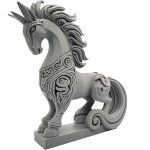
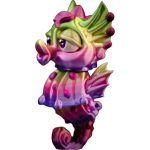
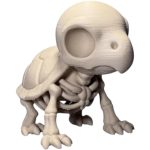
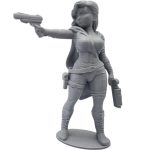
This model generates more design variety than any single corporate design department could achieve. Each artist brings a unique aesthetic perspective, cultural background, and creative specialty. The result is a catalog that spans realistic animal sculptures, fantasy creatures, articulated mechanical designs, character mashups, abstract art, and everything in between.
At 3DCentral, the catalog reflects this diversity. Original in-house designs sit alongside curated community artist models, creating a product range that no traditional manufacturer could match in scope. The Ducks collection alone features hundreds of unique designs because the community-driven model makes that breadth economically viable.
Mass Customization: A New Market Category
Traditional manufacturing produces identical units. Customization requires retooling, which means it is either impossible or prohibitively expensive for individual items. 3D printing makes individual customization economically viable for the first time.
Want a gnome in a specific color combination? A duck holding a specific accessory? A figurine scaled to a particular size? These variations cost nothing extra in tooling. The printer simply executes different instructions.
This capability creates an entirely new market category: mass customization. It is the ability to produce unique variants without retooling, and it is exclusive to additive manufacturing. For the collectibles market, mass customization opens segments that traditional manufacturing physically cannot serve.
Print farm operators with a Commercial License from 3DCentral can leverage this customization capability for their own customers, offering color variants and size options that differentiate their offerings from competitors using mass-produced inventory.
The Quality Revolution
Early 3D printed collectibles earned a reputation as rough, visible-layer curiosities that appealed mainly to technology enthusiasts rather than mainstream collectors. That era is over.
Modern FDM printing at production scale achieves surface quality, dimensional accuracy, and color consistency that satisfies serious collectors. Layer heights of 0.16mm and below produce surfaces that are smooth to the touch. Multi-color and multi-material printing enables complex color schemes without post-processing. Material science advances have expanded the available palette to include silk, metallic, matte, translucent, and glow-in-the-dark finishes.
Professional print farms calibrate and maintain their equipment to standards that hobbyist printers rarely achieve. At 3DCentral, 200-plus printers operating in a controlled environment produce consistent quality across thousands of units. Every piece undergoes inspection before shipping, a quality control process that distinguishes production-grade collectibles from hobbyist output.
Market Growth and Mainstream Adoption
The 3D printed collectibles market is growing substantially as consumer awareness increases and product quality rises. What started as a niche hobby adjacent to the maker community is moving into mainstream retail consciousness.
Several trends drive this growth. Social media showcasing of 3D printed collectibles generates organic demand as users share their collections online. Marketplace platforms make purchasing accessible to consumers with no prior 3D printing knowledge. Multichannel availability through both direct websites and platforms like Amazon reaches consumers wherever they prefer to shop.
3DCentral’s dual-channel approach, maintaining both a direct storefront and Amazon presence, reflects this market reality. Different consumers discover and purchase through different channels, and meeting them where they are accelerates market penetration.
What This Means for Collectors
For collectors, the 3D printing revolution is unambiguously positive. More designs, faster releases, better quality, and broader accessibility create an environment where building a distinctive collection has never been easier or more rewarding.
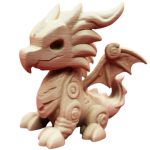
The key collector advantage is access to designs that simply do not exist in traditional retail. No mass manufacturer produces a Viking duck, an articulated crystal dragon, or a gnome holding a 3D printer. These pieces exist because the economics of 3D printing make niche designs viable, and because the community of artists creating them is vast and endlessly creative.
Collectors who enter the market now are building collections during a period of rapid expansion. Today’s catalog pieces from established artists may become tomorrow’s sought-after early editions as the market matures and mainstream adoption increases.
What This Means for Entrepreneurs
For print farm operators and aspiring entrepreneurs, the 3D printed collectibles market represents a genuine business opportunity. The barrier to entry is lower than traditional manufacturing. The design ecosystem provides product without the need for in-house sculpting talent. And subscription models like the Commercial License provide legal access to proven designs.
The market rewards operators who invest in quality, build brand identity, and develop relationships with their customer base. The same characteristics that make traditional retail succeed apply here, but with dramatically lower capital requirements and faster iteration cycles.
Frequently Asked Questions
Q: Is the 3D printed collectibles market a passing trend or a lasting shift? A: The fundamental economic advantages of additive manufacturing over injection molding for small-batch, high-variety production are structural, not cyclical. As print quality continues to improve and consumer awareness grows, 3D printed collectibles are becoming a permanent and expanding segment of the broader collectibles industry.
Q: How do 3D printed collectibles compare in quality to traditional figurines? A: Modern production-grade 3D prints achieve detail and finish quality that rivals injection-molded figurines in many categories. The surface texture is different, with visible layer lines characteristic of FDM printing, but many collectors consider this texture an authentic feature of the medium rather than a deficiency. Resin printing achieves even finer detail for premium pieces.
Q: Can I start collecting 3D printed figurines if I do not own a 3D printer? A: Absolutely. Companies like 3DCentral handle all printing, quality control, and shipping. You can browse the shop, select designs, and receive finished, ready-to-display collectibles without any printing equipment or technical knowledge.